
Why do the results from junbi differ from other pre-tests, like surveys?
In the world of advertising pre-testing, there are countless methodologies available. Each method measures human response in a fundamentally different way. This explains why your junbi scores may differ from results provided by other tools like surveys, traditional lab equipment, or emotion-based AI.
The Strategic Value
Understanding exactly what your testing tool measures prevents you from comparing apples to oranges. junbi focuses purely on predicting subconscious visual attention and cognitive processing, giving you objective insights without the interference of human bias.
Comparing common pre-test methodologies
While it is difficult to explain score differences without knowing the exact methodology of the alternative test, here are the most common differences we encounter.
- Survey-based methods: Surveys rely on conscious, subjective feedback. However, neuromarketing studies repeatedly show a significant gap between what people say they prefer and their actual real-world behavior. Participants are often influenced by personal bias toward a brand. junbi bypasses this bias entirely by predicting subconscious, objective viewing behavior.
- Emotion-based AI methods: Measuring explicit emotion, such as via facial coding AI, is a complex and evolving field. While other vendors offer emotion-based predictions, we encourage rigorous evaluation of the underlying science. In our experience, pure emotion-tracking AI still struggles to consistently and reliably predict real-world ad performance.
- Traditional neuroscientific methods: We are big advocates for real neuroscientific lab research. In fact, the predictive models inside junbi are built on this exact science like EEG and eye-tracking. Lab methods are highly accurate, but they are also costly, time-consuming, and do not allow for rapid, daily iteration. junbi was created to democratize these insights, providing the accuracy of a lab test at the speed of software.
Understanding exactly what junbi measures
At its core, junbi is an attention prediction platform. We focus on predicting subconscious visual attention and cognitive processing through our three effectiveness drivers. These are Ad Breakthrough, Brand Attention, and Cognitive Ease.
If you compare junbi to a tool designed to measure explicit emotional sentiment or conscious message comprehension, your results will naturally differ. We measure the underlying visual attention and cognitive load of the ad, not subjective opinions.
How to compare junbi with another pre-test
If you need to cross-reference data between two different platforms, follow these steps to contextualize your results.
- Identify the methodology: Check the documentation of your alternative test to confirm if it measures conscious opinions or subconscious reactions.
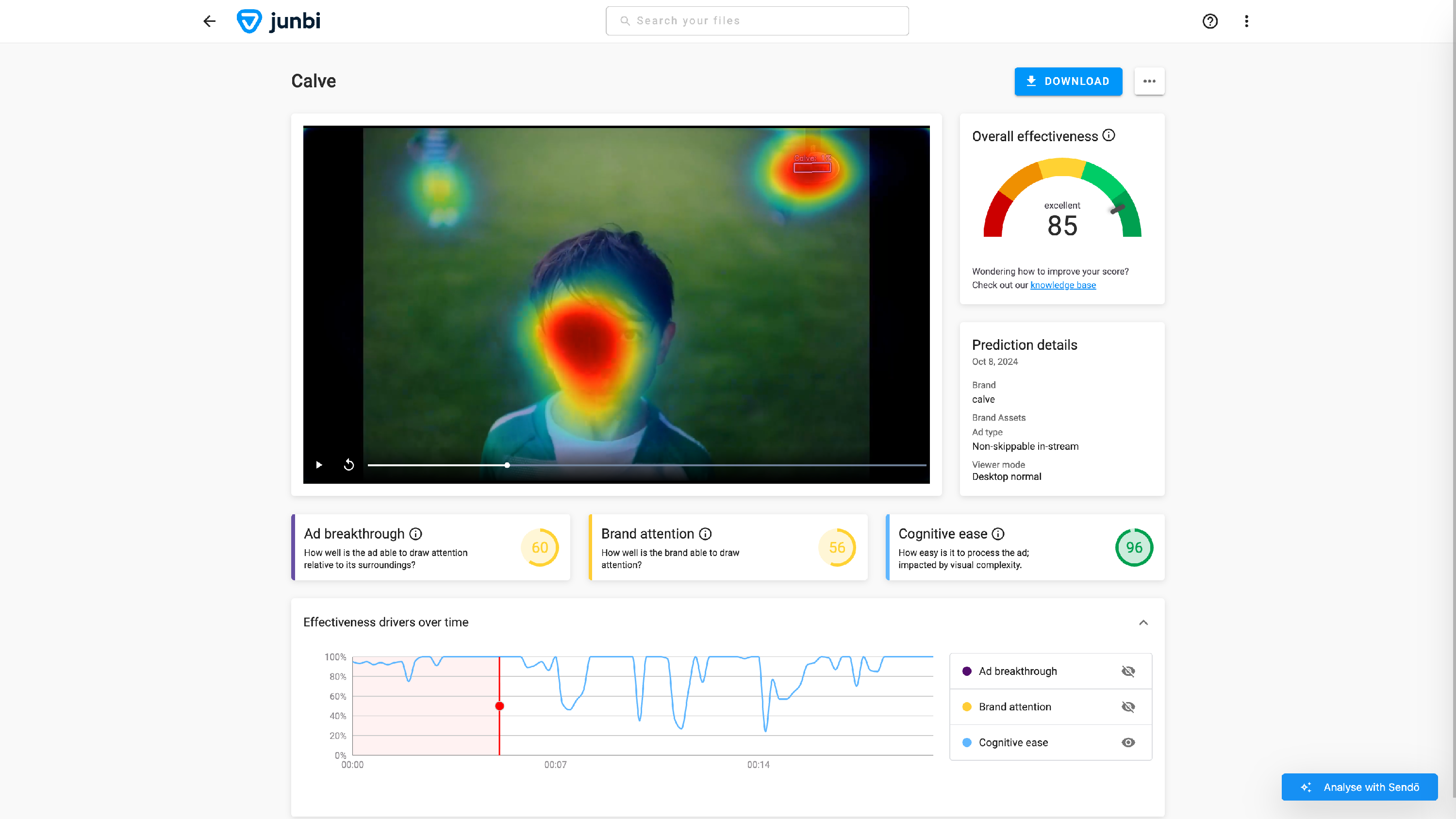
- Review your drivers: Open your junbi results and locate the effectiveness drivers over time graph at the bottom of the screen.
- Compare the data: Contrast the objective, second-by-second visual attention data from junbi against the subjective feedback of the other test. This helps you identify where viewers subconsciously disengage versus what they consciously claim to prefer.
💡 Pro Tip:
Combine data for deeper insights: If a survey-based pre-test claims viewers found your ad confusing, do not just guess where the problem lies! Open your junbi results and check your Cognitive Ease effectiveness drivers over time. This second-by-second diagnostic view will show you the exact moment visual overload occurs.